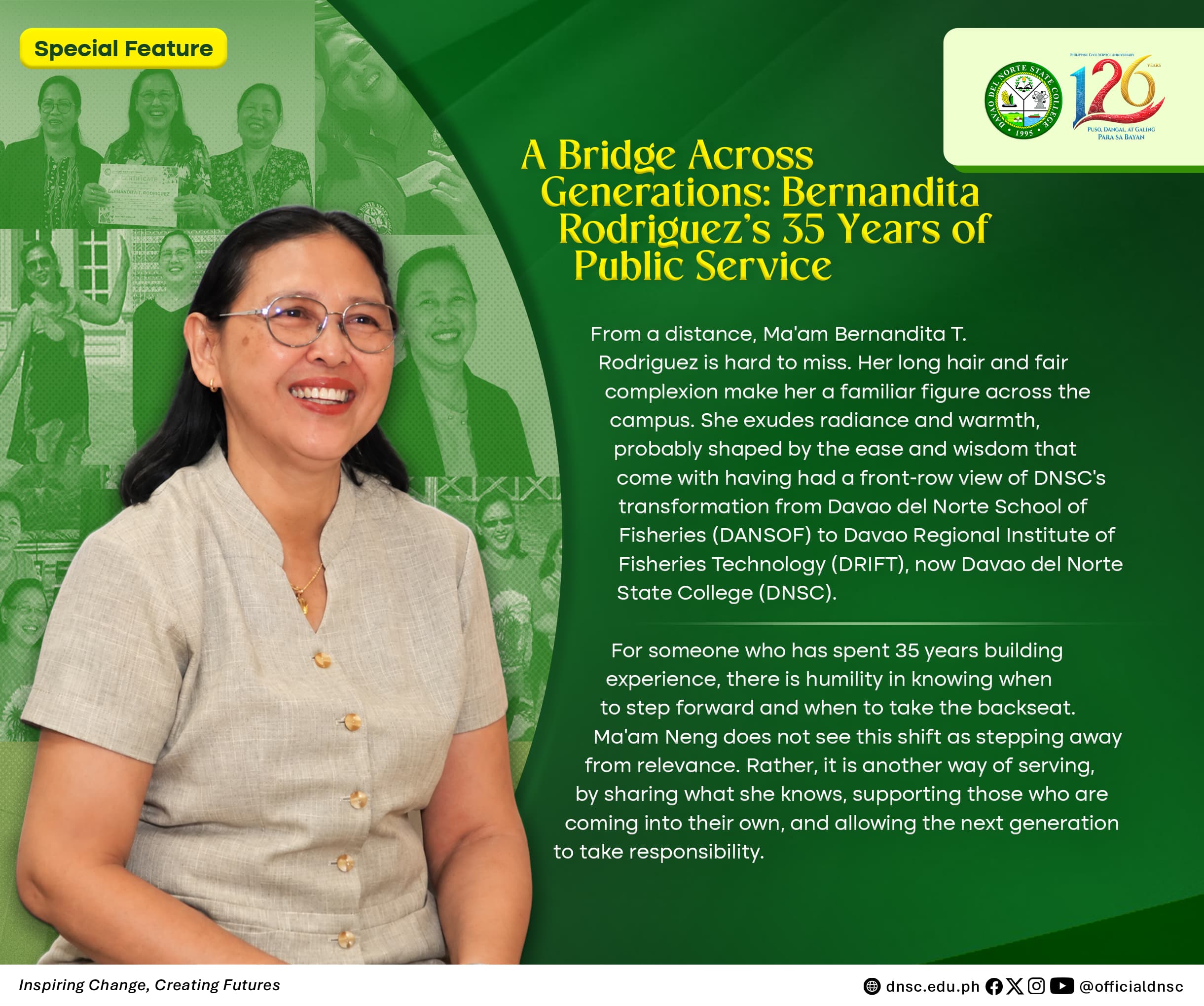
From a distance, Ma’am Bernandita T. Rodriguez is hard to miss. Her long hair and fair complexion make her a familiar figure across the campus. She exudes radiance and warmth, probably shaped by the ease and wisdom that come with having had a front-row view of DNSC’s transformation from Davao del Norte School of Fisheries (DANSOF) to Davao Regional Institute of Fisheries Technology (DRIFT), now Davao del Norte State College (DNSC).
Ma’am Rodriguez, or Ma’am Neng to most of her colleagues, began her career at DANSOF in 1991, when the institution was still under the supervision of the Department of Education and primarily served secondary students.
“Great changes have been made over time. Back then, years ago, we were bound by prompt submissions of academic-related requirements. But by 4 o’clock in the afternoon, we always had time to huddle, share stories, and laugh together before going home,” she reminisced, her face lighting up as she spoke.
Her entry into DANSOF came through a professional connection. The school was looking for a teacher with a Bachelor of Science in Fisheries degree, major in Fish Processing, for its High School Department. Dr. Francisco P. Dela Peña, a former faculty member of the College Department who later became principal of Ma’am Neng’s alma mater, the Surigao del Sur Institute of Fisheries and Aquaculture (SSIFA), now Northeastern Mindanao State University (NEMSU), informed her about the opening.
She accepted the opportunity, beginning a career that would span three and a half decades.
When DANSOF became DNSC in 1995, Ma’am Neng witnessed an institution finding new direction. She describes the transition as one that brought “dynamism” to the College’s perspective and prompted a paradigm shift.
“Karon dili na na mahitabo magtapok-tapok kay daghan na mga deliverables. Daghan na nag-retire, di na sab ko kaila sa mga bag-o karon. Lahi na sab ang generation karon sa mga newly hired,” she said, observing the changing workplace and the growing role of technology in how younger employees connect with one another.
For Ma’am Neng, adapting to these changes has been part of staying in service. She considers social skills among the qualities she would have emphasized to her younger self, particularly because they help people build relationships and adjust to different situations.
That ability to adapt was put into practice in 2007, when the rollout of the Implementing Rules and Regulations of a CHED Memorandum Order for the Fisheries Program required faculty members teaching Professional and Elective Courses to hold a fisheries professional license.
Ma’am Neng responded by obtaining the required license, allowing her to continue her teaching career. It became another defining point in a career grounded in commitment.
Reflecting on her 35 years in government service, she says the experience has shaped her through “loyalty, commitment to work, and dedication to serving the DNSC community.”
Her journey took an international turn in 2018, when she joined a benchmarking visit to Nha Trang University in Vietnam. The visit gave her a closer look at practices in student laboratory work, research, demonstrations, and the presentation of student projects. She was particularly struck by how students were encouraged to work independently and how their projects, from simple to complex, were valued through museum displays and exhibits.
The experience broadened her perspective, but her greatest measure of fulfillment remains much closer to home: her students.
“As a faculty, taking care of my students and seeing them successful in their chosen field is not just a job well done but an absolute life fulfillment,” she stated.
Today, as younger employees take on greater responsibilities at the Institute of Aquatic and Applied Sciences (IAAS), Ma’am Neng sees her role gradually taking a different shape. In the production aspect of the Institute, she is willing to assist the younger employees as they take the lead.
She cheekily expressed, “This is an example of what they say about the spirit being very much willing, but the body is already weak. At IAAS, particularly in the production aspect, which will be taken care of now by the young employees, I can serve as an assistant to them.”
For someone who has spent 35 years building experience, there is humility in knowing when to step forward and when to take the backseat. Ma’am Neng does not see this shift as stepping away from relevance. Rather, it is another way of serving, by sharing what she knows, supporting those who are coming into their own, and allowing the next generation to take responsibility.
She still considers herself fruitful and productive in preparing students for the field while looking forward to a new chapter in government service with God’s grace and blessings.
Ma’am Neng occupies a unique place in DNSC’s institutional memory. She remembers the DANSOF years, experienced the College’s transformation, worked alongside generations of employees, and taught students who have since pursued their own paths.
She remains a bridge across generations. She knows when to stand at the forefront and when to move a little to help those who came after her find their way forward. Through years of ups and downs, challenges and triumphs, she has remained humble, dependable, and steadfast, finding dignity not only in what she has accomplished, but also in what she is willing to pass on.