More than fifteen years ago, Ma’am Ann Cherry C. Cereno almost walked away from Davao del Norte State College.
She had come to DNSC expecting to apply for a substitute teaching position in Chemistry. At the time, she was already teaching part-time at Davao Oriental State College of Science and Technology (now DORSU) in Mati City, her hometown. Upon arrival, she learned that the opening was actually for another part-time position.
She wanted to turn around.
But having already made the trip, she stayed for the interview and demonstration teaching, and eventually, got the position. Looking back, Ma’am Che recognizes how easily her story at DNSC could have ended before it began, “I think if I had decided to go back that day, I might not be here at DNSC today. During the interview and demonstration teaching, I did well because of the experience I had gained over the years. I also had my master’s degree already that time.”
There was no grand decision behind her entry into government service. There was simply the practical consideration of having a stable livelihood.
“In the 90s and even today for some, government service means stability and job security. That was one of the biggest things I considered. But now, if I really think of it, choosing this stem out from a deep-seated commitment to public service,” she reflected.
DNSC was not entirely unfamiliar territory. She had previously been involved in collaborative endeavors between DNSC and DORSU, and she had relatives in Panabo City. What she did not know then was that the place she had come to almost leave would become the place where she would stay.
In her early years at DNSC, Ma’am Che held a designation in the research office. It was a different entry point into the institution, one that allowed her to work beyond the classroom.
She fondly remembered her experience with Dr. Girley Gumanao and a particular project that has remained cherished by her, “One thing I couldn’t forget that I am proud of as an output was when I worked with a small booklet authored by a Dutch researcher and I translated it into Cebuano. That was to popularize science and the understanding of biodiversity and coastal ecosystems here in our region, using our native language.”
The work was modest in scale, but its purpose was expansive. It is to take knowledge that might otherwise remain distant and making it accessible in a language familiar to the community.
She also found role models in her function as an educator, “In terms of teaching, I look up to Ma’am Nancy Raiz and now retired, Ma’am Ruby Gonzales.”
Her years in the institution would later bring her into leadership as program chair under the Institute of Teacher Education. She became part of the core team working to advance its accreditation level and pursue the Certification of Program Compliance.
The work demanded more than academic expertise.
“Before, especially during accreditation, if you were the chair, you really had to do almost everything because you did not have many members to assist you. You had to handle the photocopying and prepare the bulk of the documents yourself. Now, the process is much more collaborative and we have a system in place. Communication and teamwork have become very important,” she noted.
Going home at seven or eight in the evening was once routine as she balanced teaching and administrative responsibilities. Now, the institution has grown enough that even she sometimes finds herself surprised to be leaving on the dot.
“I experienced ITED when we were just 12 faculty members, the pioneers were still there. Now, we are already more than 70,” her excitement and awe were visible.
When asked what she would tell younger faculty members and staff, she did not begin with ambition or advancement. She began with understanding.
“I would encourage everyone to take time to understand the rules, institutional policies, and the rationale behind our procedures. Being procedural and ethical protects both the civil servant and the public. Do not come to work simply because you are there for the salary. If your motivation is only money, it may not be enough because teaching will not necessarily make you rich. What we have is not just an occupation, but a public trust,” she stated.
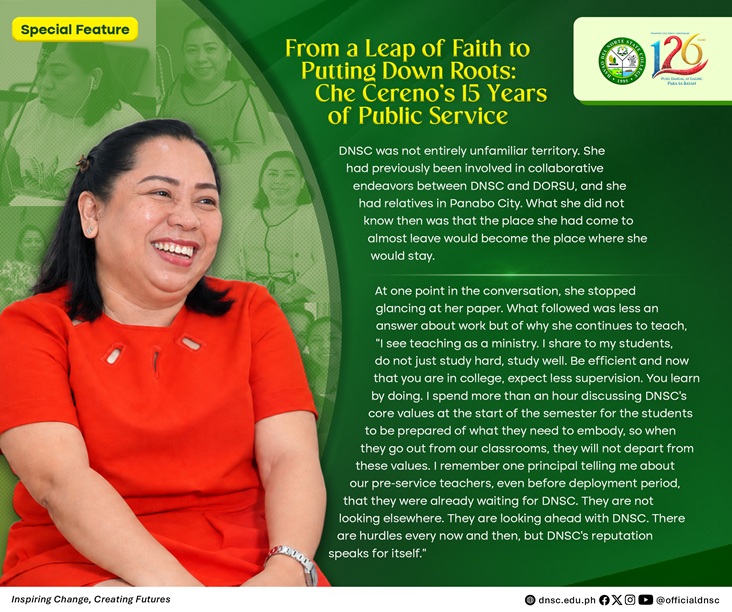
Then, at one point in the conversation, she stopped glancing at her paper. What followed was less an answer about work but of why she continues to teach, “I see teaching as a ministry. I share to my students, do not just study hard, study well. Be efficient and now that you are in college, expect less supervision. You learn by doing. I spend more than an hour discussing DNSC’s core values at the start of the semester for the students to be prepared of what they need to embody, so when they go out from our classrooms, they will not depart from these values. I remember one principal telling me about our pre-service teachers, even before deployment period, that they were already waiting for DNSC. They are not looking elsewhere. They are looking ahead with DNSC. There are hurdles every now and then, but DNSC’s reputation speaks for itself.”
Her students have since begun occupying places of their own in the institution. Some of them are now her colleagues.
“I am very happy to see them succeed. Sometimes, I even realize that they are better than me in certain areas, and that makes me proud. I am grateful, of course, to the Heavenly Father, for before, I would pray and wonder where I would be placed. I never expected DNSC, but I am right where I am meant to be,” she concluded.
Toward the end of the interview, Ma’am Che slipped in another piece of advice for young public servants, “Don’t be afraid to ask for help. That is how I survived, I consulted the wisdom of those who came before me. Do not try to carry the weight of an entire endeavor on your shoulders. The start of teamwork is communication.”
It is advice shaped by experience, the kind that comes from having done the photocopying, stayed late, learned from senior colleagues, taught students, led a program, worked through accreditation, and watched a small department become something much larger.
The irony is difficult to miss.
She had arrived expecting one kind of opportunity and found another. She had considered leaving before she had even begun, yet years later, she speaks of DNSC not as a place she happened to work in, but as somewhere she was meant to be.
Fifteen years later, Ma’am Che’s decision during the day of her interview no longer looks like a trip to life’s temporary destination. It was the first step toward building her career and putting down her roots. (end, CNL)