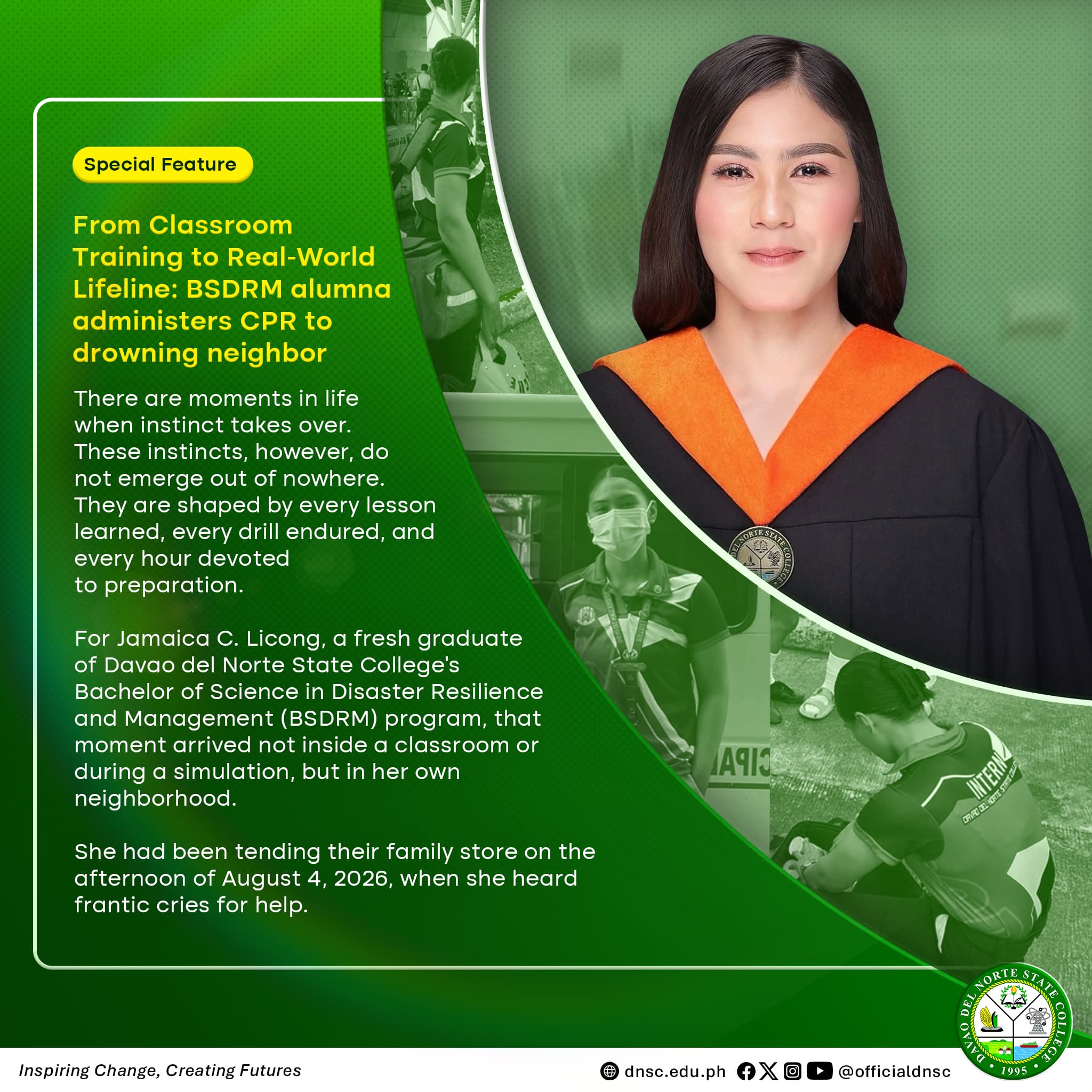
There are moments in life when instinct takes over. These instincts, however, do not emerge out of nowhere. They are shaped by every lesson learned, every drill endured, and every hour devoted to preparation.
For Jamaica C. Licong, a fresh graduate of Davao del Norte State College’s Bachelor of Science in Disaster Resilience and Management (BSDRM) program, that moment arrived not inside a classroom or during a simulation, but in her own neighborhood.
She had been tending their family store on the afternoon of August 4, 2026, when she heard frantic cries for help.
“Nakadungog ko’g syagit, ma’am. Pag-abot nako, nag-assess ko sa situation. Naa nay nag-CPR sa bata pero na-observe nako nga dili proper ang position, mao gipulihan nako ug gi-continue. Pag-abot sa ambulance ug responders, na-confirm nga nagkapulso na ang bata,” she recalled.
She quickly assessed the situation and initially thought the child had been pulled from a nearby well after drowning. She noticed that the ongoing CPR was not being performed correctly, so she took over, repositioned the child, and continued administering Basic Life Support (BLS) while waiting for emergency responders to arrive.
When the ambulance reached the scene, responders confirmed that the child had regained a pulse, allowing immediate transport to the nearest hospital. Despite the collective efforts of Jamaica and the medical team, the child passed away later that day.
For Jamaica, the incident was a heartbreaking reminder that emergency response is not about guaranteeing outcomes; it is about giving every person the greatest possible chance to survive.
Her account lasted only a few sentences. Yet behind those words were years of preparation.
The BSDRM program at Davao del Norte State College is unlike most degree programs. As the first and only BSDRM program offered by a state university or college in the Philippines, it was established to produce citizens and professionals capable of responding before, during, and after disasters.
Inside the classroom, students learn the science of disaster risk reduction. Outside it, they repeatedly practice the skills that save lives: Basic Life Support, Water Safety and Rescue, Mountain Search and Rescue, incident management, emergency planning, and disaster simulations.
“Dako kaayong tabang ang BSDRM program. Tanan nga nakat-onan nako, ako gyud na-apply sa akong pagresponde sa nalumos. Ang BSDRM dili lang kay nagtudlo ‘unsaon,’ kundi nagtudlo usab ‘unsaon paglihok’ kung naa na ang pressure,” shared Jamaica, a reminder that education prepares the mind, while training equips the hands to act. In life-threatening situations, both are essential.
Her ability to remain calm under pressure is not a coincidence. Aside from being a graduate of the BSDRM program, Ms. Licong was also a former DNSC student-athlete in Athletics, representing the College in various competitions.
Her words further reveal a reality seldom discussed in emergency response: those who help often carry invisible burdens of their own. “Nalouy gyud ko sa bata. Samtang nag-CPR ko, kahilakon na gyud ko. Wala ko kasabot sa akong gibati pagkahuman sa akong pagresponde. First time gyud to nako nga nakaresponde og ing-ana. Na-overwhelm gyud ko sa nahitabo.“
Responders are trained to save lives. No one tells them how heavy it can feel when they cannot save everyone. Perhaps that is why Jamaica’s message to fellow students carried as much weight as her actions.
She urged them not to dismiss classroom drills as mere academic requirements, “Ayaw i-take for granted ang mga basic ug ang foundation. Ang Basic Life Support ug disaster drills nga mura’g gikapoyan nato sa klase, mao na mismo ang magamit nato sa field.“
For Prof. Florie Ann L. Fermil, Dean of the Institute of Leadership, Entrepreneurship, and Good Governance, Jamaica’s experience reflects exactly what the BSDRM program hopes to produce, “The story of Jamaica proves that the BSDRM program goes beyond classroom learning; it develops capable, confident, and service-oriented disaster responders.”
Through years of intensive instruction, regular rescue simulations, the annual Rescue Skills Olympics, and service with the Student Emergency Response Team, students are prepared not merely to pass examinations, but to answer real emergencies with competence and courage.
Education is often measured by diplomas displayed on walls. But sometimes, its truest measure is found elsewhere: in a neighbor who becomes a lifeline in times of crisis, in a graduate who remembers every lesson under unimaginable pressure, and in the conviction that even when outcomes are uncertain, helping is the one thing that remains within our control. (end, CNL)