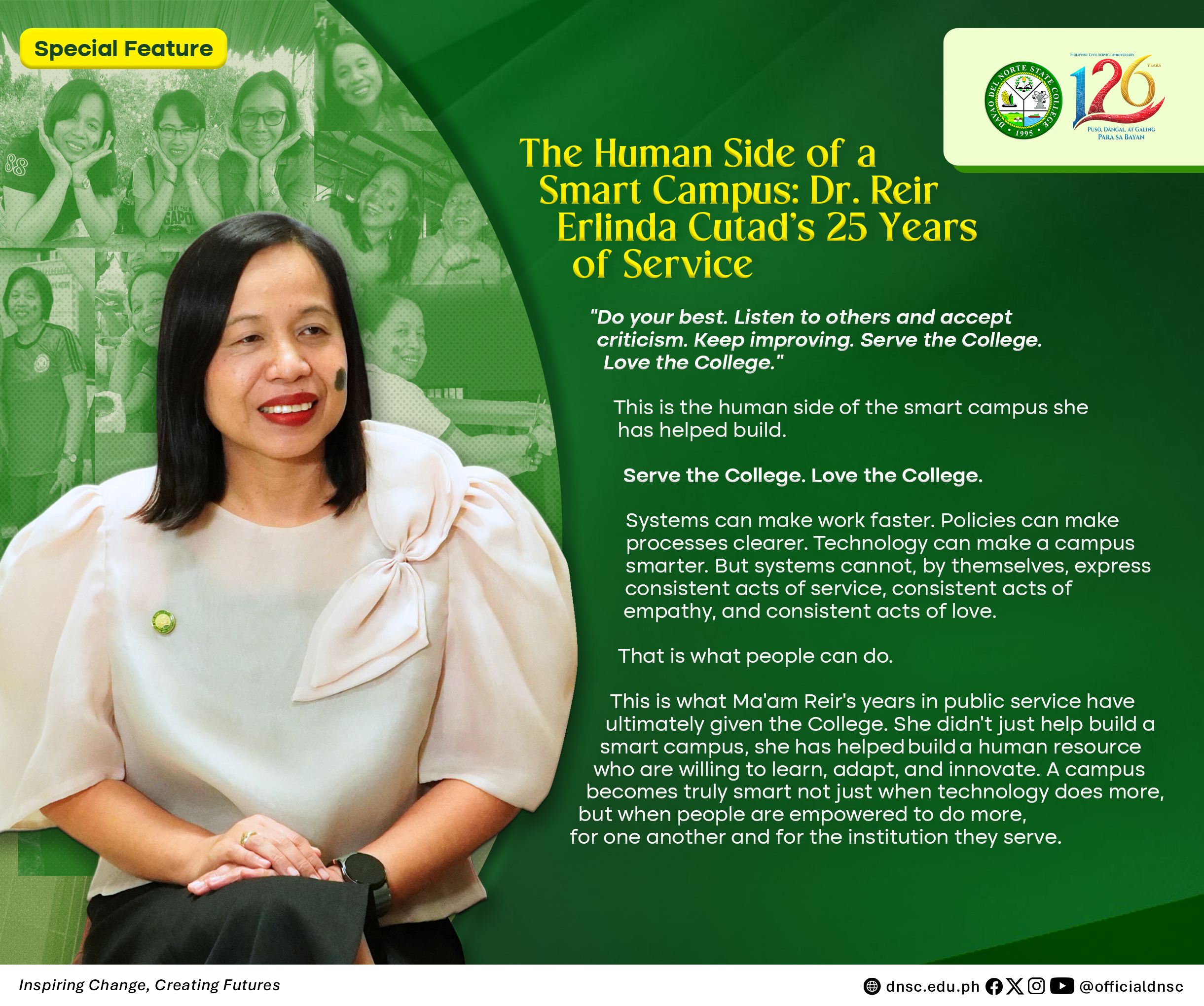
Dr. Reir Erlinda E. Cutad, Vice President for Administration and Finance and one of the prime movers of Davao del Norte State College’s Smart Campus direction, has become synonymous with innovation and efficiency.
In her speeches, she often leaves a reminder, or an encouragement, that DNSC must continue building systems through policy and programming, not simply to meet the challenges of technology head-on, but to make it work better for its people.
But behind the systems, policies, and innovations is a public servant whose own journey was shaped by uncertainty, long nights, difficult roads, faith, and the people who walked them with her.
VP Cutad began her career at DNSC when there were no online application portals, digital systems, or instant notifications. There was only a bulletin board.
She had accompanied her younger sister to the College to enroll in the BS Marine Biology program. A fresh graduate of Mindanao State University–Iligan Institute of Technology, Ma’am Reir wandered around the campus while waiting. Then, among the notices pinned to the bulletin boards, she found an announcement for a newly opened plantilla position for an Information Technology faculty member.
That small announcement would become the beginning of a journey that would last decades.
Just three weeks after taking her board exam, she was told by Human Resources that her application could not move forward unless she was enrolled in a master’s degree program. Without consulting anyone, not even her mother, whose advice she deeply valued, she went to a university and enrolled.
Later, she had to transfer schools after learning that her master’s and bachelor’s degrees were not vertically aligned for the position she was pursuing. She transferred again to a more aligned program and learned to live the demanding rhythm of working while studying.
It was a rhythm many educators know well: work by day, study when the day should have already ended.
In her first few weeks at DNSC, Ma’am Reir recalled having classes until 9 or 10 o’clock in the evening. She would wait for a friend to finish her classes, too, before the two of them made their way home through the dark roads leading away from campus.
“Imagine the fear and danger we faced during those journeys. Yet God faithfully kept us safe throughout those years.”
Decades later, the campus would look different. The way people worked would change, too.
Asked about the biggest change she has observed at DNSC, Ma’am Reir pointed to its transformation in infrastructure and technology, “The college’s ongoing infrastructure improvements and digital transformation initiatives have greatly enhanced the way we work. Although we recognize that infrastructure challenges remain due to the growing number of students and personnel, our current situation is far better than it was before.”
She remembers when the work was measured not by clicks, uploads, or digital workflows, but by stacks of paper. Accreditation requirements meant printing, scanning, photocopying, and sometimes staying overnight just to finish what needed to be submitted.
“𝘋𝘪𝘳𝘪 𝘳𝘢 𝘫𝘶𝘥 𝘮𝘪 𝘮𝘢𝘵𝘶𝘭𝘰𝘨,” she recalled with a smile.
There was only one photocopier shared among the institutes. Employees had to take turns through the night.
Technology may have changed how DNSC works, but Ma’am Reir knows that it was people who kept the institution moving when the systems were still being built. She speaks fondly of colleagues who shaped both her work and her way of leading: Dr. Girley S. Gumanao, with whom she worked on policy formulation, Performance-Based Bonus tasks, and institutional projects; Dr. Arnold Duping during their days in the planning office; and Dr. Melissa Dalumay, Dr. Leonida Piorac, Director Josiedel Santamaria, and Nurse Gemma Cervantes, whose work ethic left a lasting impression on her.
She also credits College President, Dr. Joy M. Sorrosa, for helping her understand the value of empathy and patience in leadership.
For Ma’am Reir, no one carries an institution alone. People share deadlines. They share burdens. They fill in each other’s gaps when circumstances become too heavy.
Of all the memories her years of service have given her, one remains etched in her mind.
An hour after Super Typhoon Yolanda made landfall, Ma’am Reir had to travel to Manila for an important meeting. Given the circumstances, it was a risky decision.
“Throughout the flight, there was calmness in the air. It taught me that even when surrounded by storms, literal and figurative, you can still find calmness. You can still choose calmness,” she conveyed.
Her strength to continue in the service is deeply rooted in faith and in the oath she took as a civil servant. During the interview, she cited the Panunumpa ng Lingkod Bayan as her guiding principle. Her eyes grew teary, but her voice remained firm as she uttered, “𝘗𝘢𝘯𝘨𝘢𝘯𝘨𝘢𝘭𝘢𝘨𝘢𝘢𝘯 𝘬𝘰 𝘢𝘯𝘨 𝘵𝘪𝘸𝘢𝘭𝘢𝘯𝘨 𝘱𝘪𝘯𝘢𝘨𝘬𝘢𝘭𝘰𝘰𝘣 𝘯𝘨 𝘮𝘢𝘮𝘢𝘮𝘢𝘺𝘢𝘯. 𝘔𝘢𝘨𝘭𝘪𝘭𝘪𝘯𝘨𝘬𝘰𝘥 𝘢𝘬𝘰 𝘯𝘨 𝘮𝘢𝘺 𝘮𝘢𝘭𝘢𝘴𝘢𝘬𝘪𝘵, 𝘬𝘢𝘵𝘢𝘱𝘢𝘵𝘢𝘯, 𝘢𝘵 𝘬𝘢𝘩𝘶𝘴𝘢𝘺𝘢𝘯 𝘯𝘢 𝘸𝘢𝘭𝘢𝘯𝘨 𝘬𝘪𝘯𝘪𝘬𝘪𝘭𝘪𝘯𝘨𝘢𝘯. 𝘔𝘢𝘨𝘪𝘨𝘪𝘯𝘨 𝘮𝘢𝘣𝘶𝘵𝘪𝘯𝘨 𝘩𝘢𝘭𝘪𝘮𝘣𝘢𝘸𝘢 𝘢𝘬𝘰 𝘢𝘵 𝘮𝘢𝘨𝘣𝘪𝘣𝘪𝘨𝘢𝘺 𝘯𝘨 𝘱𝘢𝘨-𝘢𝘴𝘢 𝘢𝘵 𝘪𝘯𝘴𝘱𝘪𝘳𝘢𝘴𝘺𝘰𝘯 𝘴𝘢 𝘢𝘬𝘪𝘯𝘨 𝘬𝘢𝘱𝘸𝘢 𝘭𝘪𝘯𝘨𝘬𝘰𝘥 𝘣𝘢𝘺𝘢𝘯.”
Her advice to younger civil servants reflects the experiences she has thrived on over the years, “I have learned that when God entrusts us with a mission, He also provides the strength, wisdom, and grace to accomplish it. Keep doing what is right. Never stop learning and remain faithful to your purpose. In time, you will realize that the challenges you face were not obstacles, but opportunities for growth and transformation. Serve with integrity, humility, and love. Most importantly, trust in God.”
And perhaps the most fitting advice comes from what she would tell her younger self.
“Do your best. Listen to others and accept criticism. Keep improving. Serve the College. Love the College.”
This is the human side of the smart campus she has helped build.
Serve the College. Love the College.
Systems can make work faster. Policies can make processes clearer. Technology can make a campus smarter. But systems cannot, by themselves, express consistent acts of service, consistent acts of empathy, and consistent acts of love.
That is what people can do.
This is what Ma’am Reir’s years in public service have ultimately given the College. She didn’t just help build a smart campus, she has helped build a human resource who are willing to learn, adapt, and innovate. A campus becomes truly smart not just when technology does more, but when people are empowered to do more, for one another and for the institution they serve. (end, CNL)
Congratulations and Happy 25 Years of Service, Ma’am Reir! Mabuhay ang mga lingkod-bayani!