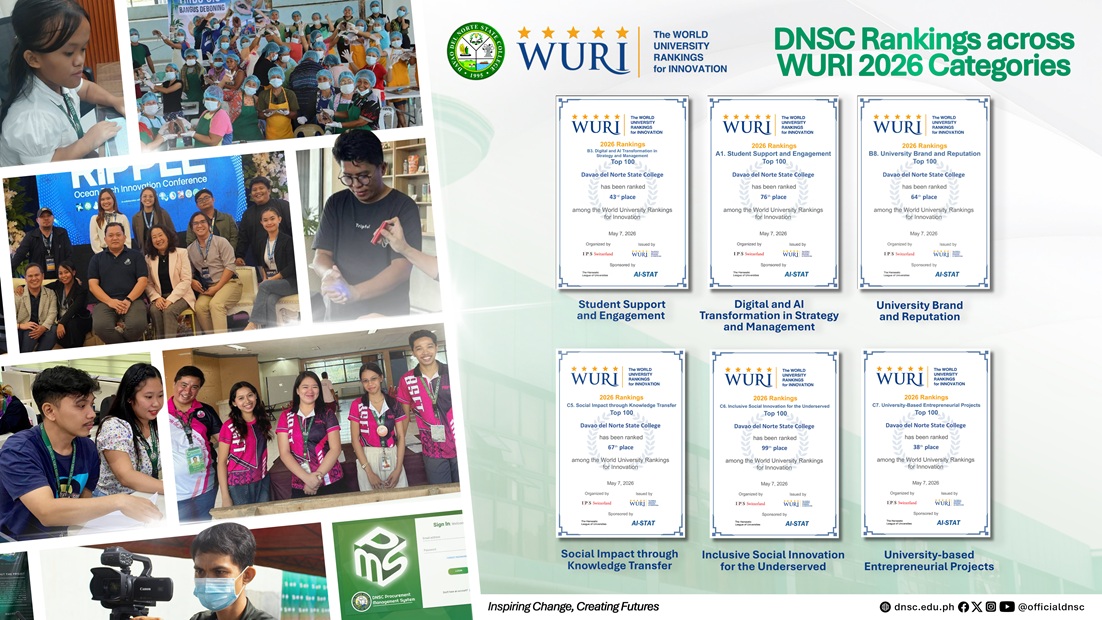
Higher education institutions refer to various metrics to assess their place in the global academic landscape. In the 2026 World University Rankings for Innovation (WURI), Davao del Norte State College earned international recognition after six of its initiatives were ranked among the Top 100 innovative cases across multiple categories.
Beyond the rankings, these projects reflect the College’s efforts to transform institutional systems while developing practical, community-centered solutions to real-world challenges. It is a delicate balance between strengthening the institution from within and creating change in the lives of the communities it serves.
Delivering Innovation to the Last Mile
Among the recognized programs is USWAG TRIBO: Community Empowerment Programs for Indigenous Peoples, which ranked 99th in Category C6: Inclusive Social Innovation for the Underserved.
At its core, the initiative reflects a principle increasingly emphasized in development science: sustainable solutions must emerge from local realities. The project grew from a Needs Assessment Study conducted among Indigenous Peoples (IPs) in Geographically Isolated and Disadvantaged Areas (GIDAs).
The findings revealed overlapping vulnerabilities: unsafe water systems, poor sanitation and hygiene, maternal and child nutrition concerns, limited livelihood opportunities, and restricted access to health information.
Rather than addressing these issues separately, the program approached them as interconnected conditions affecting community resilience. Implemented by the Extension Project Team of the Institute of Teacher Education, USWAG TRIBO combines health literacy, social preparation, livelihood empowerment, and resilience training into a multi-phase intervention.
Its significance lies in recognizing that marginalized communities are not passive recipients of aid, but active knowledge holders whose participation determines whether interventions endure beyond project timelines.
Digital Backbone of Institutional Resilience
While USWAG TRIBO addressed geographic isolation, another DNSC initiative confronted a different form of fragmentation: disconnected digital systems.
The DNSC Information Systems Gateway: A Unified Digital Ecosystem ranked 43rd in Category B3: Digital and AI Transformation in Strategy and Management.
Developed entirely in-house by the System Development Unit, the initiative emerged during the operational disruptions caused by the COVID-19 pandemic.
More than a recovery mechanism, the Gateway represents a shift in how educational institutions understand digital infrastructure, not merely as administrative support, but as a strategic governance tool. Through business process reengineering and agile development methods, DNSC consolidated institutional services into a secure ecosystem enabled by Single Sign-On technology.
In practical terms, users can navigate multiple institutional systems through a unified digital identity, reducing redundancies and improving workflow efficiency.
From a systems science perspective, integration matters because fragmented information structures slow decision-making, weaken transparency, and create operational inefficiencies. The project exemplifies that innovation in higher education does not always require imported technologies; localized and context-specific solutions can emerge from institutional expertise itself.
Redefining Employability through Inclusion
Innovation is often associated with technology, yet one of DNSC’s recognized programs focused on something equally transformative: access.
The ABLE Initiative: Enabling Inclusion, Enabling the World ranked 76th in Category A1: Student Support and Engagement, reframing employability through the lens of social equity.
DNSC adopted the term “Equity Target Students” to refer to learners from historically marginalized sectors, including first-generation college students, children of farmers and fisherfolk, Indigenous Peoples, persons with disabilities, and rebel returnees.
Through the Career and Job Placement Unit, the College launched ABLE—short for “All Belong for Livelihood and Employment.” Programs such as the Government Internship Program (GIP), Special Program for the Employment of Students (SPES), and Cash for Work Program (CFWP) provided financial support and professional exposure for students navigating economic barriers.
Employment assistance was treated not simply as job placement, but as an intervention against structural inequality. In effect, the initiative acknowledged that talent exists across all sectors, but opportunity does not.
Branding as Collective Memory and Identity
Communication itself became a field of innovation through Anchoring Our Identity: The #SAILwithDNSC Branding Campaign, which ranked 64th in Category B8: University Brand and Reputation.
At first glance, branding may seem distant from science. Yet communication studies increasingly recognize that institutional narratives shape public trust, stakeholder relationships, and organizational cohesion. In this sense, branding is not merely promotional work, it is the deliberate construction of meaning, identity, and shared purpose.
Anchored on DNSC’s Five-Year Strategic Plan (2025–2029), the campaign transformed the institution’s core values: Stewardship; Adaptability and Excellence; Integrity and Innovativeness; and Love of God and country, into the acronym “SAIL”.
The sailing metaphor carries both historical and symbolic weight. It ties the institution’s future aspirations to its origins as the former Davao del Norte School of Fisheries, founded to bring education closer to fishing communities across the province.
Through this metaphor, the campaign functions not only as a branding initiative, but also as an act of institutional remembrance, preserving the College’s roots while charting its direction forward.
What distinguishes the initiative is its evidence-based approach. Rather than relying solely on aesthetics or intuition-driven publicity, the campaign uses analytics, stakeholder feedback, and digital engagement metrics to assess audience reach, perception, and impact in real time.
Food Safety as Preventive Public Health
Another DNSC initiative highlighted how scientific knowledge can directly influence everyday public health.
Safe Plates, Healthy Communities: Enhancing Food Safety Practices of Vendors in Panabo City ranked 67th in Category C5: Social Impact through Knowledge Transfer.
Implemented by the Extension Project Team from the Institute of Aquatic and Applied Sciences, in partnership with the Local Government Unit of Panabo City, the program focuses on improving food handling practices among vendors through sustained annual seminars and community engagement.
Food safety is often overlooked until outbreaks occur. Yet global public health studies continue to identify improper food handling as a major source of preventable disease. By improving knowledge on sanitation, hygiene, and food handling, the initiative reduces health risks while protecting livelihoods dependent on food vending.
Its impact also extended into policy development. Research findings were presented before the Regional Research, Development, and Innovation Committee (RRDIC XI), while a draft local food safety ordinance underwent deliberation within the city government.
This progression, from research to policy, illustrates how universities can function as active contributors to governance and public health reform.
Building a Blue Economy through Innovation Ecosystems
The highest-ranked DNSC initiative, placing 38th in Category C7: University-based Entrepreneurial Projects, addressed a growing global concern: sustainable economic development linked to marine and aquatic resources.
The BUGSAI Technology Business Incubator (TBI) is the first and only State Universities and Colleges-based TBI in Davao del Norte focused on Information and Communications Technology (ICT) solutions for the Blue Economy.
Supported through the DOST-PCIEERD HEIRIT Program, BUGSAI was established in response to the province’s lack of structured startup incubation systems despite its strong fisheries, aquaculture, marine tourism, and MSME sectors.
The incubator supports startups, researchers, and students working on innovations involving fisheries, marine biodiversity, aquaculture, logistics, and seafood value addition.
Scientifically, the initiative reflects the growing global movement toward “blue economy” models, economic systems that utilize marine resources sustainably while balancing environmental protection and community development.
BUGSAI provides mentorship, research and development support, intellectual property assistance, prototyping facilities, and industry matching. Together, these elements form what innovation theorists describe as an “innovation ecosystem,” where ideas move beyond laboratories into viable technologies and enterprises.
The six WURI-ranked initiatives vary widely in discipline, from public health and Indigenous empowerment to digital systems, communication strategy, and entrepreneurship. Yet they share a common thread: all respond to societal challenges through evidence-based interventions.
Collectively, the recognitions suggest a broader transformation in how universities define innovation.
In DNSC’s case, innovation is not confined to invention alone. It is reflected in safer food systems, accessible employment pathways, culturally grounded communication, resilient digital infrastructure, sustainable enterprise ecosystems, and empowered Indigenous communities.
The WURI citations therefore represent more than institutional milestone. They substantiate the growing role of higher education institutions as living laboratories where science becomes practical, local, and deeply human.