‘The judge gave me a life sentence; SETBI gave me a life contract’ – one of the graduates of the College Education Behind Bars
At the entryway of the first floor of the College Education Behind Bars (CEBB) building inside the Davao Prison and Penal Farm (formerly DAPECOL), six Persons Deprived of Liberty (PDLs) sat with their loved ones and mentors. Their eyes were fixed on the gymnasium, where flowers adorned the stage and rows of neatly arranged chairs awaited what guests described as a “renewal of hope” and “restoration of dignity.”
Act I: Life Sentence
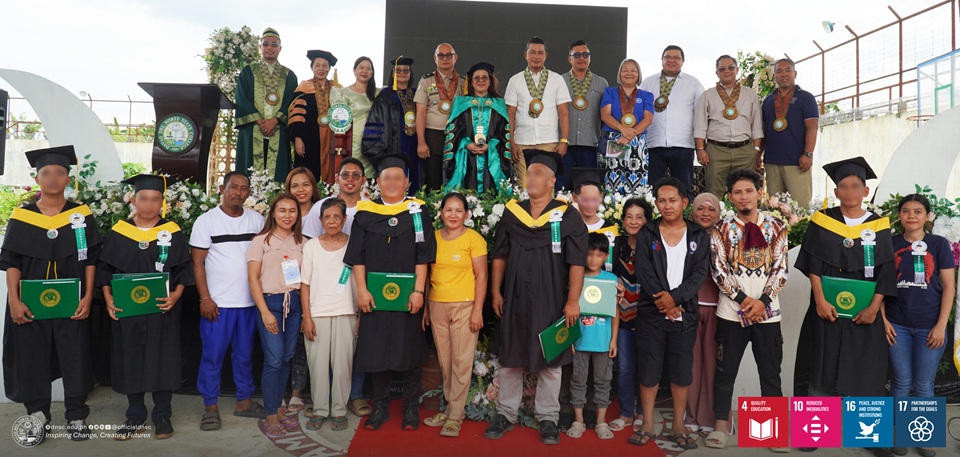
The event was part of Davao del Norte State College’s 47th Commencement Exercises for the Class of 2025, specially dedicated to the graduating PDLs. Six of the seven CEBB graduates marched on August 26, 2025, while one joined the main campus ceremony on June 27. All received the degree of Bachelor of Science in Entrepreneurship.
The CEBB was initiated by the Social Entrepreneurship, Technology, and Business Institute (SETBI), led by its President and Founder, Dr. Aland David Mizell, and Vice President, Atty. Susan P. Cariaga. Davao del Norte State College responded to SETBI’s call for partnership through a Memorandum of Agreement signed by SUC President III, Dr. Joy M. Sorrosa, and witnessed by Dr. Girley S. Gumanao, Vice President for Academic Affairs.
“The judge gave me a life sentence; SETBI gave me a life contract… On April 18, 2025, Good Friday, after more than twenty years in prison, I was released. My sentence was life imprisonment, and I knew I still had additional years before being considered for parole. Yet I was free. I thought freedom was something God would never grant me, but He did,” said Rodolfo (alias), sharing his story on behalf of his batchmates.
Act II: The Right to Education
In his welcome remarks, Dr. Mizell shared that the College Education Behind Bars program has produced 120 graduates nationwide, most of whom are employed and have achieved a zero recidivism rate. Recidivism refers to the tendency of a person who has been previously convicted of a crime to reoffend or return to criminal behavior after release from incarceration or completion of a sentence. This low rate demonstrates that rehabilitation is possible and that a fundamental human right, such as education, can be extended even to those deprived of freedom.
It takes time and dedication from both educators and volunteers to carry out programs like CEBB, and their efforts are remembered by the PDLs who have been given a second chance at life. Rodolfo expressed his gratitude to SETBI and DNSC, “When I asked Doc Aland for advice, he urged me not to return to my old habits and to make wise choices. I told him that my past mistakes had already cost me almost 21 years of my life, and I would not allow that to happen again.”
Act III: Faith and Healing
The graduation was made more special with the attendance of award-winning actor and former Philippine representative for culture and the arts to the United Nations Educational, Scientific and Cultural Organization (UNESCO), Cesar Montano. He described witnessing the graduation as a form of healing. He emphasized that the nation needs healing, and it is in stories of success and transformation, like those of the CEBB students, that the power for reconciliation and restoration can be found.
He quoted 2 Chronicles 7:14, “If my people, who are called by my name, will humble themselves and pray and seek my face and turn from their wicked ways, then I will hear from heaven, and I will forgive their sin and will heal their land.”
Montano then looked up and pointed to the CEBB students watching from the restricted second-floor balcony. He declared, “Your past does not define your future. Hindi ikaw ang kahapon. Ikaw ang ngayon. Heal from within.”
The idea of healing, especially “healing the land”, is deeply rooted in the traditions of several indigenous communities in Mindanao. The Higaonon and Manobo, for example, hold rituals to reconcile with the guardians of the land when it has been harmed or when conflict disrupts harmony.
From time immemorial, long before we called it history, the concepts of restoration and healing have been with us. In the context of the College Education Behind Bars, this ancient wisdom finds a modern expression: giving the incarcerated an opportunity to heal and the tools to transform. And perhaps, in healing them, we also begin to heal our nation. (end, CNL)